
Pixel Logic
About this game
Crack the row and column clues, fill the right squares and reveal a hidden pixel picture. 12 puzzles from 5x5 to 10x10, beat the clock!
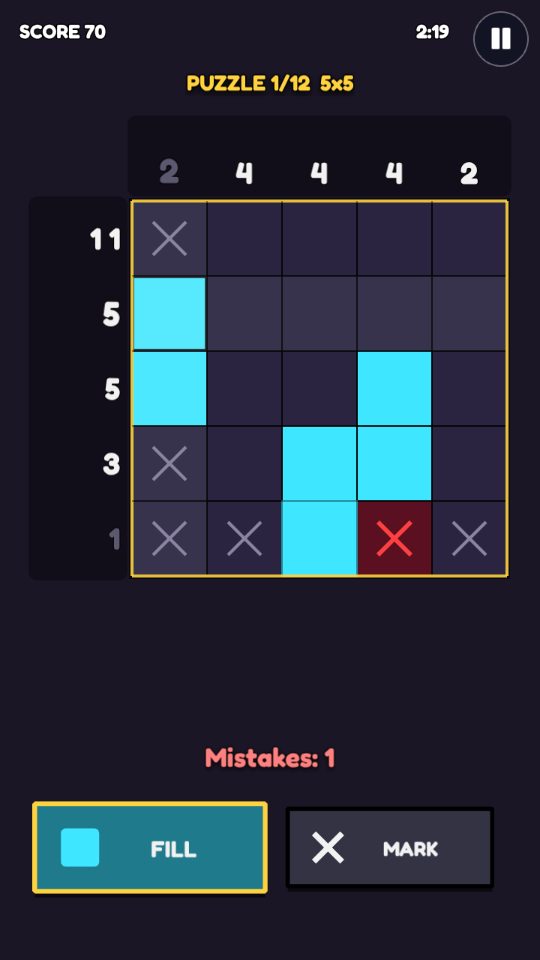
Pixel Logic is a picture-logic puzzle, the kind also known as a nonogram. Every row and column of the grid comes with a clue: the lengths of its runs of filled squares, in order. A clue of 3 1 means a run of three, at least one empty square, then a single square. Working out from the clues alone which squares are filled draws a hidden pixel picture, which bursts into its real colours the moment the last square goes in.
There are twelve puzzles, always in the same order: four 5×5 grids starting with a heart, four 8×8 and four 10×10, ending with a ship. Every one can be solved by logic, line by line, without guessing.
One clock runs through the whole game. You start with a minute, and each puzzle adds time: 90 seconds for a 5×5, 150 for an 8×8 and 240 for a 10×10. Seconds you save carry over. A wrong square is crossed in red and costs 10 seconds; if the clock reaches zero, the answer is shown and the run ends. Solve all twelve to win.
How to play
- Read the clues to the left of each row and above each column. A 0 means the line is empty; such lines are crossed out from the start.
- In FILL mode, tap a square or drag along a row or column to paint squares. A drag stays on the line where it started.
- Switch to MARK to put an X on squares you know are empty; tap a mark again to remove it.
- When a row or column is complete, its clue greys out and its remaining squares are crossed for you.
Controls
- Keyboard
- The arrows or WASD move the cursor. Space, Enter or Z fills (or marks, in MARK mode); hold it while moving to do the same along a line. X marks or unmarks, and M or Tab switches between FILL and MARK. Esc or P pauses.
- Touch
- Tap or drag on the grid. The FILL and MARK buttons under it switch modes.
- Mouse
- Click or drag across the squares, and click FILL or MARK to change mode.
Tips
- Start with the biggest clues. In a 10-square line, a run of 7 must cover the middle four squares wherever it sits, because its leftmost and rightmost positions overlap there.
- Add up the clue plus one gap between each run. If the total equals the line length, as with 3 1 on a 5×5, the whole line is decided.
- Mark empty squares as you find them. Marks are not just notes: in FILL mode a marked square cannot be painted by a slip of the finger.
- Never guess. A wrong square costs 10 seconds and the 300-point PERFECT! bonus for that puzzle.
- Move quickly through the 5×5 grids. Every second you save there is banked for the 10×10 puzzles at the end.
Features
- Twelve pixel pictures from 5×5 to 10×10
- FILL and MARK modes, with drag painting
- Finished lines cross themselves out
- One shared clock, with time added for every puzzle
Frequently asked questions
Do I ever have to guess?
No. Every puzzle can be solved by reading one row or column at a time, so there is always a square you can be sure of.
How are points scored?
Each correct square scores 5 and each finished row or column 20. A solved puzzle adds 100 per row of its size, so 500, 800 or 1,000, plus 300 with no mistakes. Solving all twelve adds 5 points for every second left.
Are the puzzles the same every time?
Yes. The twelve pictures always come in the same order, so speed and accuracy decide your score.
Tags
- #nonogram
- #retro